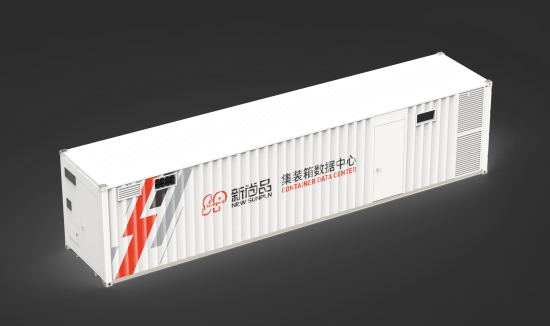
Prefabricated data centers refer to the integration of equipment modules into containers in the factory in advance and the completion of tests. Upon arrival at the site, these containers were quickly assembled like "Legos" to form a complete data center. Its advantages lie in the fact that it is decoupled from civil construction, not restricted by on-site conditions. All mechanical and electrical equipment is pre-integrated and pre-tested in the factory. Once connected to the municipal power supply, network and water source, it can operate independently. The prefabrication and assembly rate is high, and the integration work is carried out in parallel with the on-site civil construction work, thus shortening the construction period.
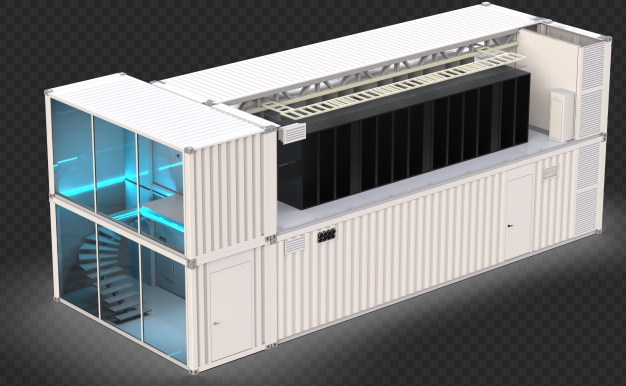
Meanwhile, based on their different functions, containers can be classified into eight types of functional boxes: IT, power, integrated cold stations, integrated cold sources, office, corridors, elevators, and stairs. They can be flexibly combined according to different scenarios and scales, and deployed in zones based on power segments to match different computing power application scenarios. For customers, in the initial stage, they can deploy as needed based on their capital level and computing power requirements. In the later stage, they can flexibly upgrade and expand online according to the computing power equipment and the data center model. While supporting horizontal expansion, it can also achieve vertical on-demand expansion, with the maximum expansion capacity reaching up to 5 layers.
In addition, the current construction of data centers must take green energy conservation into account. Over the past decade, the thermal design power (TDP) of cpus has nearly doubled, while the thermal design power of Gpus has risen from less than 200W in 2008 to 1000W at present, and the power density per cabinet has climbed from 5kW to over 100kW. However, the increase in deployment density brought by Scale Up is the prerequisite and foundation for the continuous expansion of Scale Out Scale. Advanced cooling technologies such as liquid cooling and intelligent temperature control will solve the heat dissipation problems caused by Scale Up. This means that hundreds of megawatts of data centers with large land occupation and high energy consumption will be further compressed to be more compact and more energy-efficient.




 Home
Home